How to Read a Casino Poster Without the Hype
Read a casino poster without the hype: notice its imagery, layout and language, then separate the mood it creates from details a passer-by can verify.
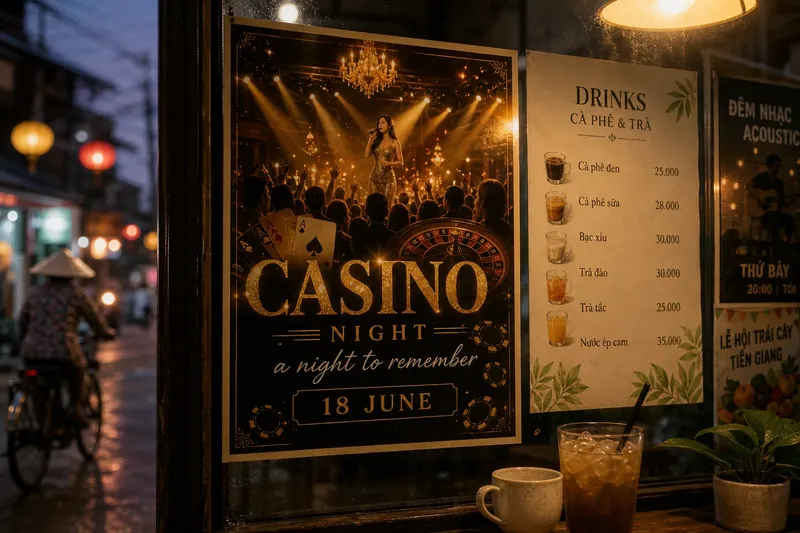
A gold-lit casino poster sits beside a café’s drinks menu in Mỹ Tho, its headline larger than the date beneath it. To read a casino poster without the hype, look at how the design directs attention and what practical details it leaves easy—or difficult—to find.
That small act of looking can be useful in a place where entertainment notices, restaurant offers and local announcements share public space. A poster is also an object people may pass, discuss or ignore; its design can prompt those different encounters without telling us what any one person thinks.
A poster occupies a particular public space
Start with where it appears: a café window, a shop wall, a noticeboard or a phone screen. Record what sits nearby. Karaoke adverts, music-night flyers or festival notices may make the poster part of a larger patchwork of leisure offers, rather than the whole story of a street.
Placement affects who is likely to notice it. A sheet at eye level beside the till meets a different audience from a display facing a busy pavement. You can describe that position without assuming who stopped to read it or what they made of it.
Try writing the setting in one plain sentence before interpreting the image.
Images can borrow the look of a night out
Look for the visual ingredients: a stage, playing cards, a dressed-up figure, a chandelier, a crowd or a bright wash of colour. These can borrow familiar signs of an evening’s entertainment. They show what the artwork chooses to foreground, not what a visitor will encounter.
Notice how the elements are arranged. If a singer’s face fills the centre while the venue name sits in a corner, the image gives the face more visual weight. That is a statement about composition, not about the organiser’s identity or the event’s character.
“A crowd appears beneath a row of lights” stays close to what is visible. “Everyone will have a lively evening” turns an image into a prediction.
Colour and local references shape the mood
Gold against black may suggest glamour; red capitals may feel emphatic; a soft-edged photograph may give the layout a more intimate tone. Tie each description to a visible choice rather than treating the mood as a fact about the event.
A place name, Vietnamese phrase or familiar regional motif can anchor the design in Tiền Giang. It may be a way to catch local attention, but it cannot stand in for the varied ways residents feel about casino leisure. People can respond differently, and a poster does not record those responses.
Separate the artwork’s invitation from the conversation around it.
Read the headline separately from the arrangements
Promotional wording such as “a night to remember” or “your lucky moment” invites a feeling. It does not tell a reader where an event takes place, who is organising it or what conditions apply.
Look for details that can be checked directly on the poster: event name, date, venue, organiser, contact route and any written terms. If a line is too small or partly covered, call it unclear. Do not fill the gap with a guess.
If an offer depends on conditions or local rules, the poster may not contain enough information to answer every question. The organiser’s written terms or a suitable local source may be needed.
Reading order can hide useful details
Follow the route the design offers your eyes: perhaps a bright image first, then a large slogan, then a narrow strip of small print. The most prominent part may be easiest to remember, while the date or venue takes more effort to locate.
Say you are looking at an invented café poster in Mỹ Tho. Its starting details are a gold stage image, the slogan “a night to remember”, a printed date of 18 June, no visible street address and no readable offer conditions. You first describe the image as stage lighting and gold lettering, without calling the event glamorous. Next, you copy the slogan as promotional language, not as a promise about the evening. Then you record the date exactly as printed, while marking the address and conditions “not visible”. The resulting description identifies what a passer-by can learn and what remains unanswered; if the venue matters, the sensible next action is to seek a clear organiser contact rather than infer the location.
What can a casino poster tell you?
Can the design show whether an offer is genuine?
It can show the offer’s printed wording, but polished artwork does not verify the terms. Read any conditions and organiser details, then seek an appropriate local source if the wording remains unclear.
What does a lucky symbol mean?
A horseshoe, card or number motif shows how the designer has chosen to frame chance. It does not establish what will happen at an event or tell you how a viewer interprets the symbol.
Does a local phrase mean residents approve?
No. A Vietnamese phrase or place name may connect the artwork to its intended setting, but it cannot speak for residents as a group. Describe the reference and leave community opinion to people expressing their own views.
How should I describe dramatic wording?
Quote the phrase accurately and identify it as promotional language. Then distinguish its suggested mood from concrete information such as a date, venue or written condition.
Check the details before describing the poster
These checks help keep a description grounded in what is actually visible. Each result points to a clear next action:
- Observe the setting: if the poster is in a café window, describe that placement; if you cannot identify where it appeared, mark the setting as unknown instead of naming a venue.
- Observe the main image: if a stage or card is clearly visible, name that object; if the image is indistinct, describe its colours or shapes rather than assigning it a meaning.
- Observe the headline: if the event name is legible, copy it accurately; if it is obscured, record the title as unclear rather than reconstructing it.
- Observe the date: if the printed date is readable, record it as shown; if it is missing or covered, leave the timing unresolved instead of inferring it.
- Observe the venue information: if an address or identifiable venue is printed, note it; if neither appears, mark the location as unavailable and seek organiser details only if you need them.
- Observe the offer terms: if the conditions are legible, describe what they say; if they are absent or unreadable, do not treat a slogan as the complete offer.
- Observe the language and type size: if the practical details are easy to read, note where they appear; if they are cramped or faint, describe that barrier and avoid assuming every passer-by can read them.
A clear account can be brief: name the setting, the most prominent design choices, the wording and the practical information that remains unavailable.
Keep the description open to other views
Reading a casino poster without the hype means describing its imagery and language while keeping the claims modest. A poster can show how someone chose to present an invitation; it cannot tell you how people in Tiền Giang respond to casino leisure, or what they say about it among friends.
That distinction leaves room for the next useful question: not only what the artwork asks a passer-by to notice, but what the passer-by chooses to say about it.